
When patients seek out my services for treating children with learning related vision problems, one of the frequent questions that I am asked is: “Why did my previous optometrist not catch this problem?”
This is a great question and here is the explanation. When people seek out an optometrist, the issue is usually that they cannot see clearly. If someone cannot see clearly, whether due to being nearsighted, farsighted, having astigmatism, or because they are at the age where reading glasses start becoming necessary, the issue is always a lack of visual clarity. Those of us who do vision therapy on a daily basis see certain trends and notice certain commonalities among those who need high prescription lenses. Namely, their eyes do not work as a team nor focus accurately very well. However, the fact that they need lenses means that they are applying additional voluntary effort in order to overcome the weaknesses they have in their focusing system. The extra effort that is applied causes their eyesight to change over time, hence the worsening eyesight.
If this is so, then those who do not need glasses to see clearly must logically fall into two camps – either they have no vision problem at all and therefore they have high visual function in addition to having excellent eyesight, OR…they have poor function but are not applying any extra muscle effort, hence they have poor visual function but excellent clarity of eyesight! Such patients would test 20/20 in both eyes, but when testing their binocular vision we find that the quality of the binocular fusion, accuracy and range of their focusing system, and the accuracy of their subjective response are all abnormal. These abnormalities can cause issues with:
-
Poor reading comprehension
-
Loss of place while reading
-
Poor spelling
-
Poor retention of reading material
-
Poor spelling
-
Poor handwriting
-
Inattentiveness at school
-
Slow processing speed
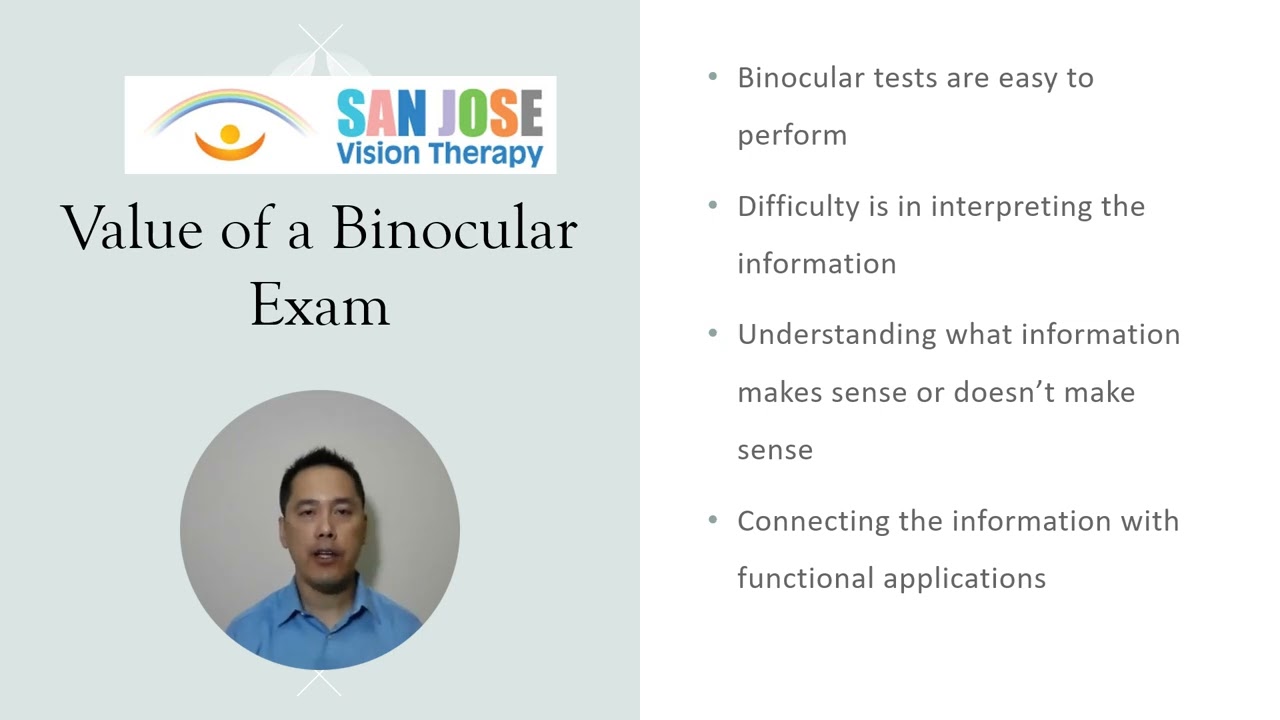
The unfortunate fact is that a binocular vision test is a very subjective test. We rely on the patient to tell us whether they see clearly or blurry, single or double. If there is any inaccuracy in what they perceive, that inaccuracy ruins the diagnostic process of determining what type of vision problem is present. Therefore, if a patient’s subjective feedback is inaccurate, their feedback will make the vision problem much harder to identify without an eye specialist that focuses on binocular vision problems and vision therapy. I hope this answers your questions about why it’s wholly necessary for a specialty office like ours to repeat a previous doctor’s eye exam.
FAQs:
What are binocular vision problems?
Binocular vision problems occur when the two eyes have difficulty working together efficiently, which can affect focusing, eye coordination, reading, and visual comfort.
Can a regular eye exam miss binocular vision problems?
Yes. A routine eye exam may confirm that vision is clear and the eyes are healthy without fully evaluating how effectively the eyes work together as a team.
How are binocular vision problems diagnosed?
A comprehensive binocular vision assessment can evaluate eye teaming, focusing, tracking, depth perception, and other visual skills to identify functional vision problems.
Tags: Binocular Vision, Binocular Vision Problems, Eye Coordination, Eye Exams, Functional Vision Problems, Optometry Exams, Vision Therapy, Visual Processing